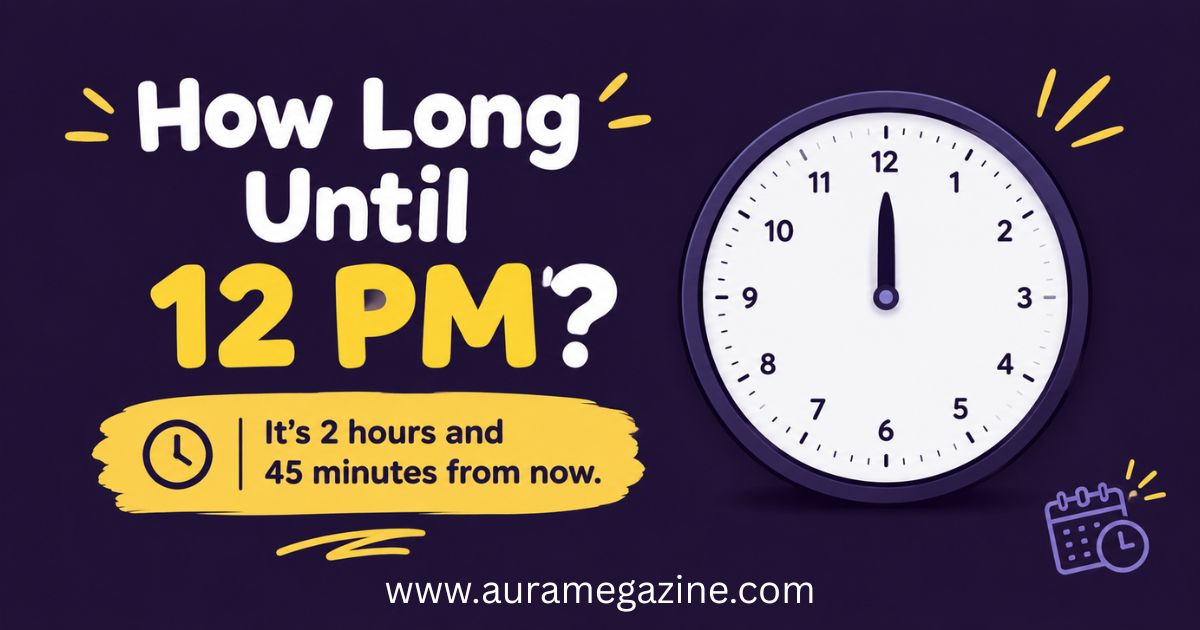
How Long Until 12 PM? Complete Guide
Checking the clock and doing quick math in your head sounds easy until you’re mid task and lose count. Most people ask “how long until 12 pm” during a work shift, before a scheduled call, or while timing something like a fast or a medication dose.
The good news is the calculation only needs two steps once you know the trick. This guide breaks down the exact method, shows where people usually slip up, and gives you a few practical ways to use that number once you have it.
What Does 12 PM Actually Mean?
12 PM is noon, the midpoint of the day on a standard 12-hour clock. It sits exactly between midnight and midnight, splitting the day into a morning half and an afternoon half.
A lot of confusion comes from the AM and PM labels themselves. Midnight is 12 AM, and noon is 12 PM, which trips people up because the numbers don’t increase in the direction you’d expect. On a 24-hour clock, none of this matters. Noon is simply 12:00, full stop.
Noon at a Glance
Here’s a quick reference table for how noon fits into different time systems and common reference points.
| Detail | Value |
| 12-hour clock label | 12:00 PM |
| 24-hour clock label | 12:00 |
| Position in the day | Exact midpoint |
| Common nicknames | Midday, high noon |
| Opposite point | 12:00 AM (midnight) |
| Solar noon | Varies by location, rarely matches clock noon exactly |
| Typical use cases | Lunch breaks, meeting deadlines, fasting windows, medication timing |
Keep this table handy if you’re the kind of person who mixes up AM and PM under pressure. Almost everyone does at some point.
How to Calculate How Long Until 12 PM
The direct answer: take the current time, work out the minutes remaining in the current hour, then add the full hours left until noon. That’s the whole method, and it takes about ten seconds once you’ve done it a few times.
The Bridge Method, Step by Step
Most people mess up because they try to subtract the current hour from 12 in one move. That works fine at the top of the hour, but it falls apart the second minutes get involved. The bridge method fixes that.
- Look at the current time.
- Find how many minutes remain until the next full hour.
- Count the full hours from that next hour to 12.
- Add the two numbers together.
Here’s a worked example. Say it’s currently 9:42 AM.
- Minutes left until 10:00 AM: 18
- Full hours from 10:00 AM to 12:00 PM: 2
- Total time until noon: 2 hours and 18 minutes
Try another one. It’s 11:07 AM.
- Minutes left until 12:00 PM: 53
- No additional full hour needed since you’re already in the last hour before noon
- Total time until noon: 53 minutes
The method scales the same way no matter what time you start from, which makes it a lot more reliable than guessing.
Common Mistakes to Avoid
A few errors show up again and again when people calculate this by hand.
- Straight subtraction without adjusting minutes. Seeing 9:42 and assuming “about 2 hours and 42 minutes” is wrong. You have to flip the minutes, not carry them over as is.
- Forgetting AM versus PM. If it’s already past noon, you’re not counting down to 12 PM anymore, you’re counting toward 12 AM the next day, which is a totally different math problem.
- Rounding too early. Rounding 18 minutes to “about 20” feels harmless, but it adds up if you’re timing something precise, like a countdown for a timed test or a kitchen recipe.
- Ignoring time zones on shared schedules. If a meeting invite says 12 PM and your team spans two regions, that noon isn’t the same moment for everyone.
Small errors like these rarely matter for a casual lunch break. They matter a lot more when you’re timing medication, a fast, or an exam window with a hard cutoff.
Read More: 45+ Rune Symbols and Meanings: Complete Elder Futhark Guide
Why the Clock Format Trips People Up
The 12-hour clock repeats itself twice a day, which is exactly why AM and PM exist in the first place. It’s a compact system, but it comes with a built in ambiguity that the 24-hour format avoids entirely.
On a 24-hour clock, noon is just 12:00 and there’s nothing left to interpret. Midnight is 00:00, and every hour after that climbs steadily until you hit 23:59. Pilots, the military, and most of Europe default to this format for exactly that reason: fewer chances for a scheduling mix-up.
If you regularly work across time zones or handle bookings that need to be airtight, switching your phone’s clock display to 24-hour format removes one entire category of mistake. It looks unfamiliar for about a week, then becomes second nature.
Manual Math vs a Countdown Tool
Doing the bridge method in your head works fine for a one-off check. But there are situations where a running countdown beats mental math every time.
When manual math is enough:
- You just want a rough idea, like “is it almost lunch yet”
- You’re checking once and moving on
- You already know the current time exactly
When a countdown tool helps more:
- You need a live, second-by-second timer for something like a timed test
- You’re setting a reminder well ahead of noon, such as ten minutes before, to wrap up a task
- You want an alarm rather than something you have to keep checking manually
Most phones already include a countdown or alarm feature buried in the clock app. Setting a specific alarm for 11:50 AM, for instance, gives you a built in warning before noon actually hits, which beats refreshing a countdown page every few minutes.
Practical Reasons People Track the Time Until Noon
This isn’t just idle clock watching. A surprising number of daily routines hinge on knowing exactly how far off noon is.
- Work shifts. Many jobs split the day at lunch, so noon marks a real transition point rather than just a number on a clock.
- Intermittent fasting windows. A lot of fasting schedules use noon as the start or end of an eating window, which makes precise timing genuinely useful rather than optional.
- Medication schedules. Some prescriptions are timed around midday doses, and being off by twenty minutes can matter more than people assume.
- Exam and test deadlines. Timed academic or certification tests often use noon as a submission cutoff, and last minute panic makes mental math unreliable exactly when accuracy matters most.
- Meeting scheduling across regions. A noon call for one office might land at a completely different hour somewhere else, so confirming the actual local time avoids an awkward no show.
Fast Facts About Noon
- Noon splits the day into two exact 12-hour halves
- 12 PM and 12 AM are the two “hinge points” of the 12-hour clock
- Solar noon and clock noon rarely line up exactly because of time zones and daylight saving adjustments
- The 24-hour clock avoids AM/PM confusion entirely by using 12:00 for noon
- The bridge method (minutes to the next hour, then full hours to noon) is the fastest manual calculation
- Countdown alarms work better than repeated manual checks for time sensitive tasks
- Noon based schedules are common in fasting, medication, and exam timing
- A shared “12 PM” on a calendar invite can mean different actual moments across time zones
Wrapping Up
Working out how long until 12 PM comes down to one simple habit: handle the minutes first, then count the full hours. Once that method clicks, you’ll stop second guessing yourself every time the clock doesn’t land on a round number.
Whether you’re timing a lunch break, a fasting window, or a hard deadline, that extra bit of precision keeps your schedule running the way you actually planned it.
Frequently Asked Questions
Is 12 PM noon or midnight?
12 PM is noon. Midnight is labeled 12 AM instead, which is the part most people find counterintuitive at first.
How do I quickly calculate the time left until noon?
Find the minutes left in your current hour, then add the full hours remaining until 12. That two step method is faster and more accurate than direct subtraction.
Why do 12 AM and 12 PM feel backwards?
The 12-hour clock resets twice daily, and neither reset point fits neatly into the usual “AM equals morning” logic, which is exactly why the confusion persists.
Does solar noon match clock noon?
Rarely. Time zones and daylight saving time shift the clock away from the sun’s actual highest point, sometimes by close to an hour.
What’s the easiest way to avoid noon mix-ups on shared schedules?
Confirm the specific time zone attached to any “12 PM” meeting invite, since the same label can point to different actual moments for remote teams.

Mubeen is a passionate writer at Auramegazine who explores symbolism, hidden meanings, and powerful signs behind everyday symbols. He enjoys creating simple, engaging content that helps readers understand deeper meanings and cultural connections.