55+ Powerful God Symbols and Their Spiritual Significance
God symbols are among the oldest forms of human communication, used long before written language existed to express the divine, the sacred, and the eternal. From cave paintings in prehistoric Europe to the gold-leafed temples of ancient Egypt, these symbols have carried the weight of human belief for thousands of years. They aren’t just decorations. They’re compressed stories about creation, power, protection, and the meaning of life itself.
If you’ve ever felt something stir inside you when you saw a cross, an Om, or the Eye of Horus, that reaction isn’t accidental. These sacred symbols speak to something deep in the human mind, something older than religion, older than culture, and older than language.
This guide covers over 55 powerful god symbols from cultures around the world, explains their true meanings, and helps you understand why they still matter today.
What Are God Symbols?
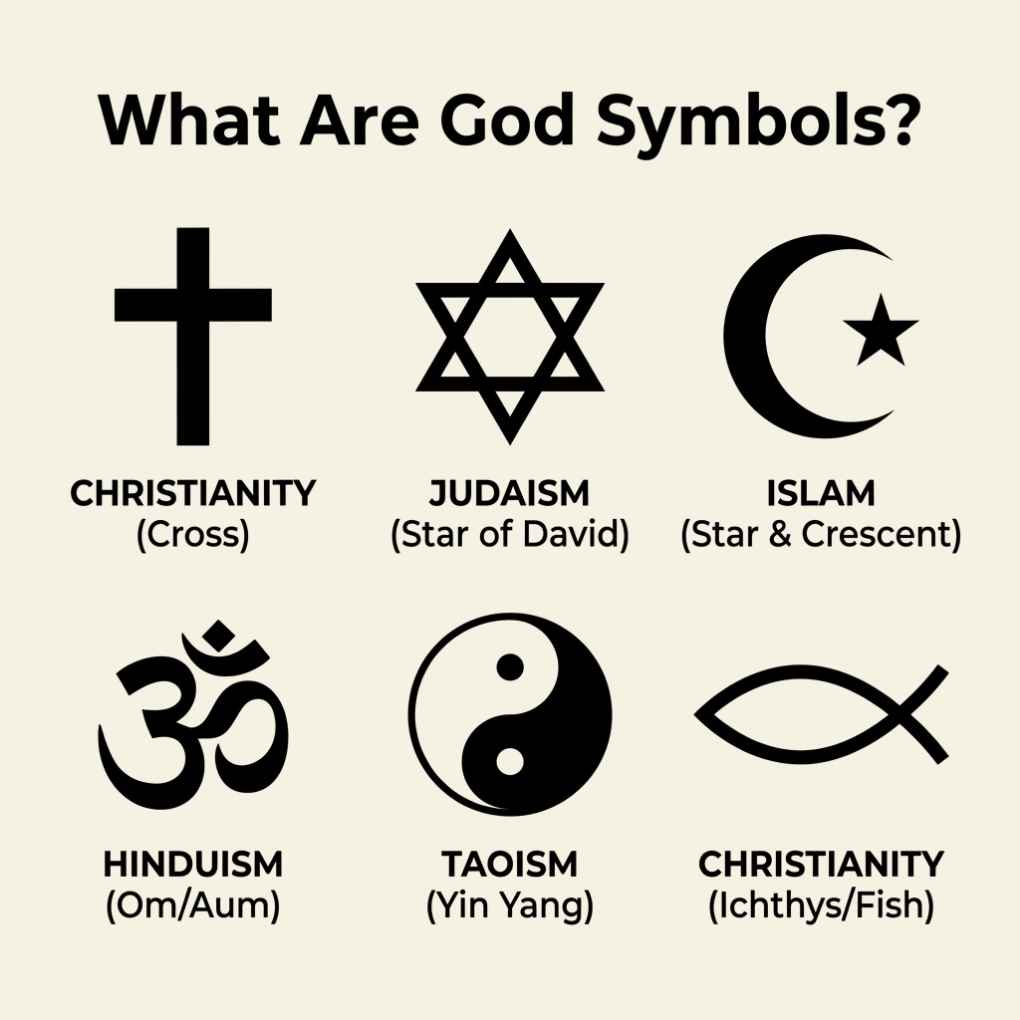
God symbols are visual representations of divine presence, power, or nature. Instead of describing a deity through long stories alone, a single sacred sign can capture divine authority, protection, love, creation, or cosmic balance in one image. That’s exactly why they’ve been so effective across every civilization in history.
Before organized religion took shape, early humans used the sun, moon, animals, and geometric patterns to explain forces they couldn’t understand. Over time, these images developed into complex religious iconography seen in temples, scriptures, jewelry, and art.
What makes god symbols so fascinating is that similar ones appeared in cultures that had no contact with each other. The sun as a symbol of divine light shows up in ancient Egypt, the Aztec empire, Hinduism, and Norse mythology independently. That kind of overlap tells you something important: these symbols tap into universal human experiences, not just regional traditions.
God Symbols You Can Copy And Use Easily
God Symbols Text
Text-based god symbols are simple characters you can use anywhere, from social media bios to digital art to personal messages. They communicate faith and spiritual identity in a clean, minimal way.
Here are some of the most widely recognized ones:
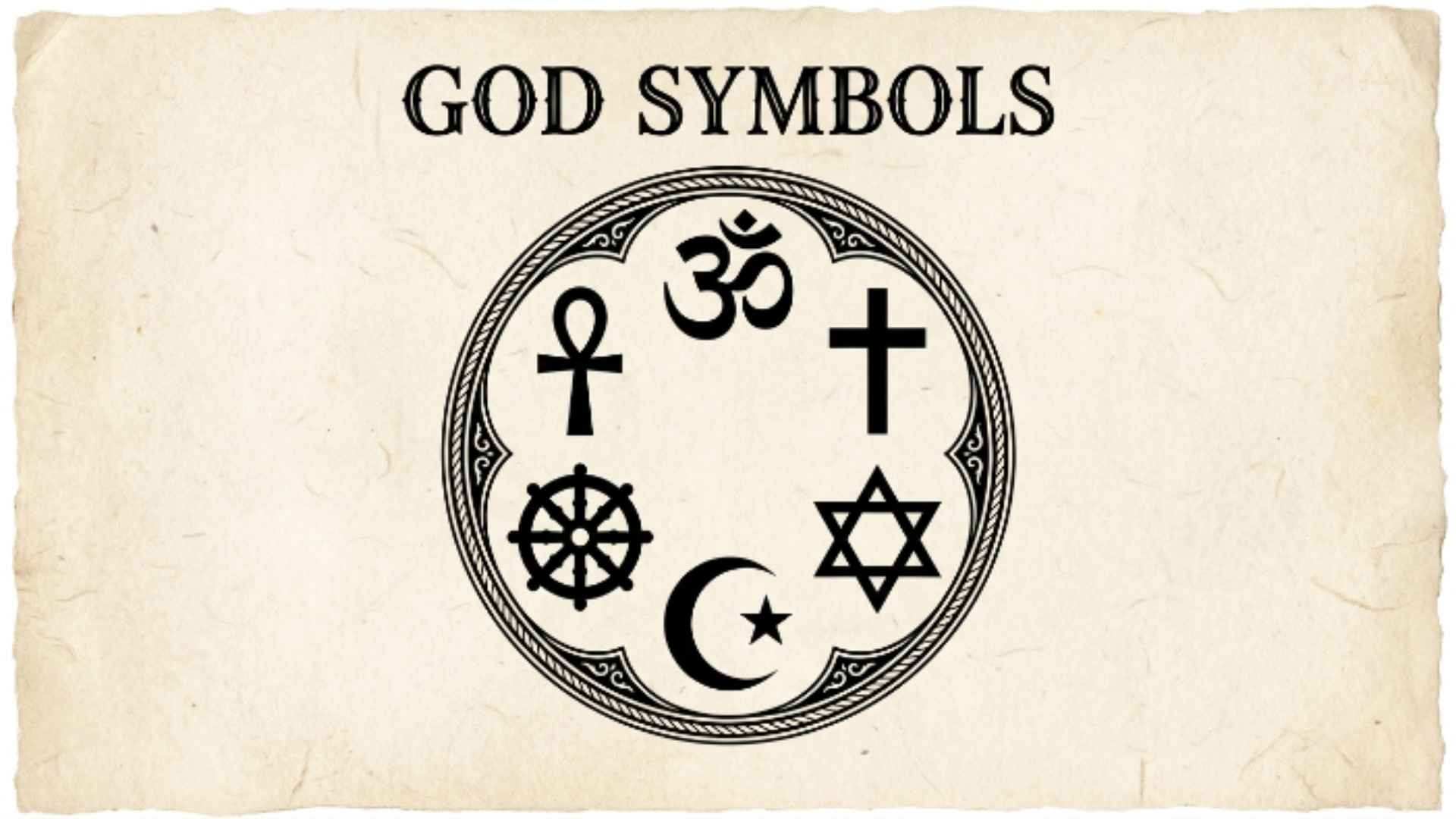
- ✝ Latin Cross (Christianity)
- ☦ Orthodox Cross (Eastern Christianity)
- ☪ Crescent and Star (Islamic cultural symbol)
- 🕉 Om (Hinduism, Buddhism, Jainism)
- ✡ Star of David (Judaism)
- ☯ Yin Yang (Taoism)
- 🔱 Trident (Hinduism, Greek mythology)
Each of these carries centuries of meaning. The Om symbol alone is considered one of the most sacred sounds in Hindu spiritual practice, representing the primordial vibration of the universe.
God Symbols Copy And Paste
These symbols are incredibly popular in online communities because they’re universally recognized and instantly communicate belief. People use them in Instagram bios, Twitter captions, email signatures, and spiritual content.
What’s interesting is how these symbols cross cultural lines online. You’ll regularly see someone combine a cross with an Om in their bio, not out of disrespect, but because digital culture has made spiritual identity more layered and personal than ever before.
Powerful God Symbols And Meanings
God Symbols And Meanings
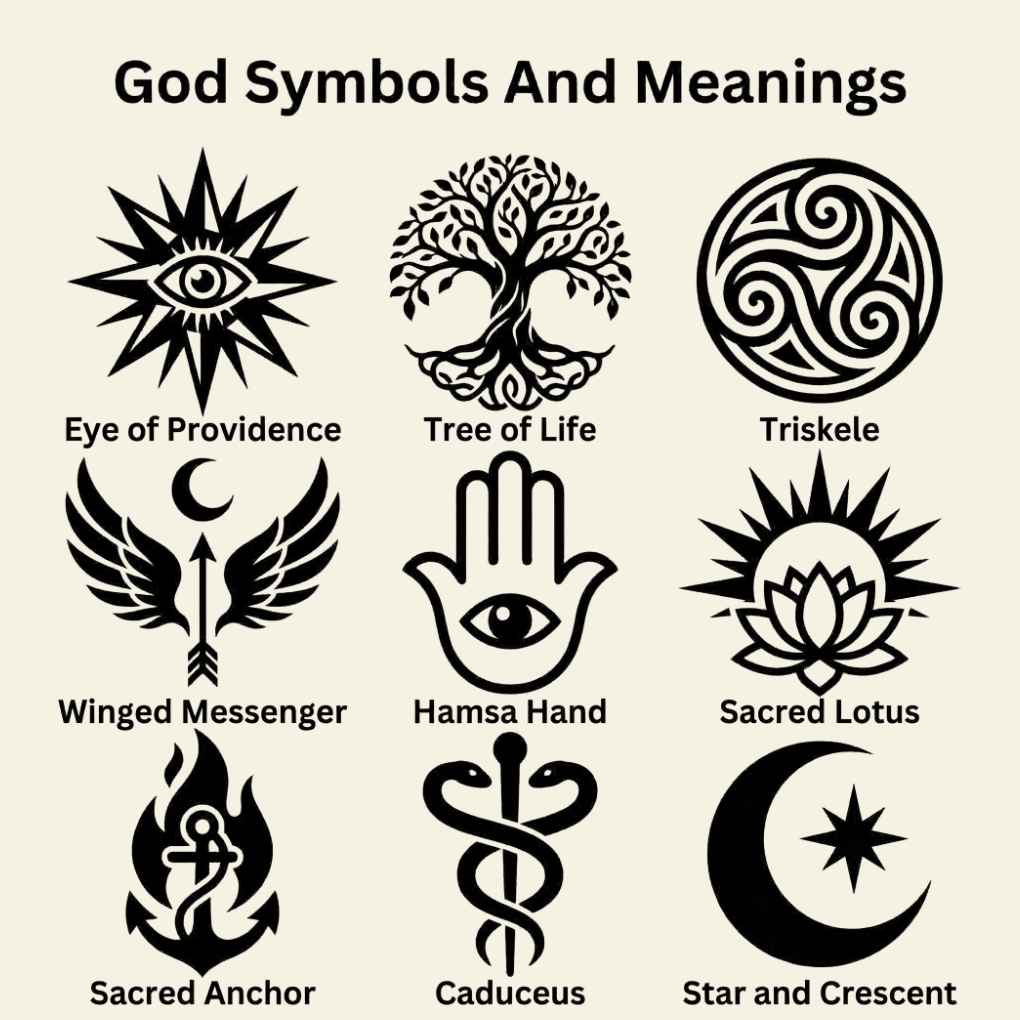
The most universally recognized god symbols each carry layers of meaning that go far beyond their simple appearance.
The Cross represents sacrifice, divine love, and salvation in Christianity. The Eye of Horus stands for protection, healing, and royal authority in ancient Egypt. The Lotus flower symbolizes spiritual awakening and purity across Hindu and Buddhist traditions because it grows through muddy water to bloom beautifully above the surface. The Triangle often represents the divine trinity, whether that’s the Christian Father, Son, and Holy Spirit, or the Hindu Brahma, Vishnu, and Shiva.
What unifies all of these is that they encode complex theological ideas into a single image that anyone, even a child, can recognize.
Powerful Spiritual Symbols And Meanings
Beyond religious traditions, certain symbols carry what many describe as inherent spiritual power. The Mandala represents unity and wholeness, used in Buddhist and Hindu meditation for centuries. The Infinity symbol suggests eternal existence and the cyclical nature of life. The Spiral appears in Celtic stone carvings over 5,000 years old and is thought to represent growth, evolution, and the journey toward higher consciousness.
These symbols show up in modern American wellness culture constantly. Walk into any yoga studio, meditation center, or holistic healing space in the US and you’ll see mandalas on the walls, spirals in logos, and lotus flowers everywhere.
Powerful Spiritual Symbols
One category often overlooked is sacred geometry. Shapes like the Flower of Life, Metatron’s Cube, and the Vesica Piscis are believed by many spiritual traditions to encode the mathematical structure of creation itself. These aren’t just pretty patterns. Across ancient Egyptian temples, Islamic geometric art, and even Renaissance paintings, you find the same ratios and forms appearing with remarkable consistency.
Greek God Symbols And Meanings
God Symbols Greek
Greek mythology gave the Western world some of its most enduring divine symbols. These ancient religious symbols didn’t disappear with the Greek empire. They became embedded in art, science, philosophy, and eventually modern pop culture in ways that still shape daily American life.
Greek God Symbols
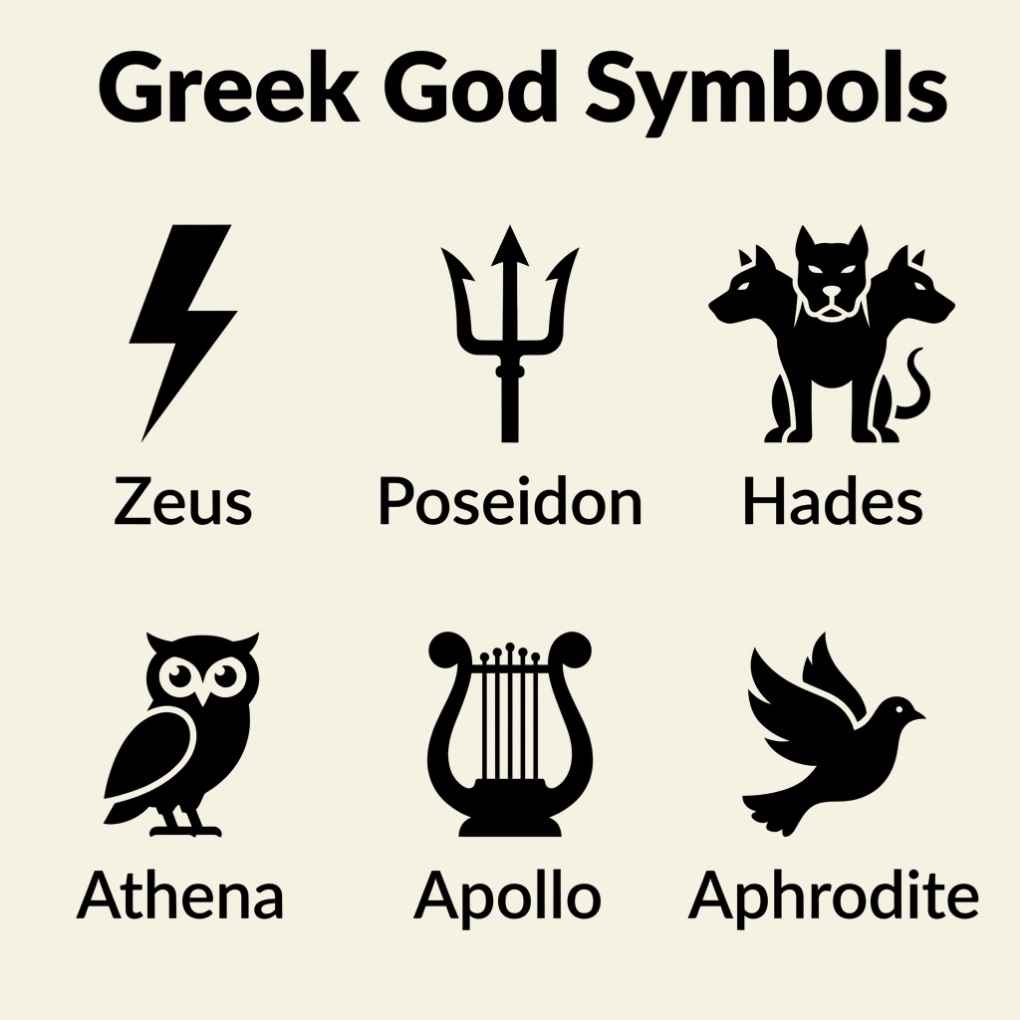
Here’s a quick reference for the major Greek gods and their primary symbols:
| God | Primary Symbol | Meaning |
| Zeus | Lightning Bolt | Divine authority, cosmic power |
| Poseidon | Trident | Control over sea and earthquakes |
| Athena | Owl | Wisdom, strategic intelligence |
| Apollo | Lyre and Sun | Music, light, prophecy, healing |
| Ares | Spear and Shield | War, aggression, conflict |
| Hermes | Caduceus, Winged Sandals | Speed, communication, commerce |
| Hades | Helm of Darkness | Death, the underworld, hidden power |
| Artemis | Bow and Moon | Hunting, wilderness, the moon |
| Aphrodite | Dove and Rose | Love, beauty, desire |
Greek Gods Symbols And Meanings
Each of these symbols wasn’t randomly assigned. They reflect the personality and domain of the god directly. Zeus’s thunderbolt wasn’t just about raw power. It represented divine judgment being hurled from the heavens. Athena’s owl represented the ability to see in the dark, a metaphor for wisdom piercing through ignorance.
Greek God Symbols Percy Jackson
Rick Riordan’s Percy Jackson series introduced millions of American kids to Greek mythology through modern storytelling. In the books, each demigod carries their parent’s symbol as a kind of birthright identifier.
Percy Jackson bears Poseidon’s trident, Annabeth Chase carries Athena’s owl. These symbols helped young readers connect ancient mythology to relatable characters, sparking a massive cultural revival of interest in Greek god symbols across the US.
You May Also Like: Jeep Dashboard Symbols and Meanings: The Ultimate Warning Light Guide Every Driver Must Know
Greek God Symbols Tattoos
Greek mythology tattoos are consistently among the most popular tattoo choices in America. A Zeus lightning bolt tattoo often represents personal authority and resilience. The Athena owl tattoo is chosen by people who identify with wisdom and strategy. Poseidon’s trident is popular among surfers, sailors, and anyone with a deep connection to the ocean.
Before getting a mythology tattoo, it’s worth understanding what the symbol actually meant in its original context. That knowledge makes the tattoo more meaningful and avoids misrepresentation of sacred cultural heritage.
Other God Symbols
Roman God Symbols
Roman gods largely borrowed from Greek mythology but carried distinct cultural identities. Jupiter (Zeus) uses the lightning bolt. Mars (Ares) is represented by the spear and shield. Venus (Aphrodite) is symbolized by the mirror. Mercury (Hermes) shares the caduceus and winged sandals.
Egyptian God Symbols
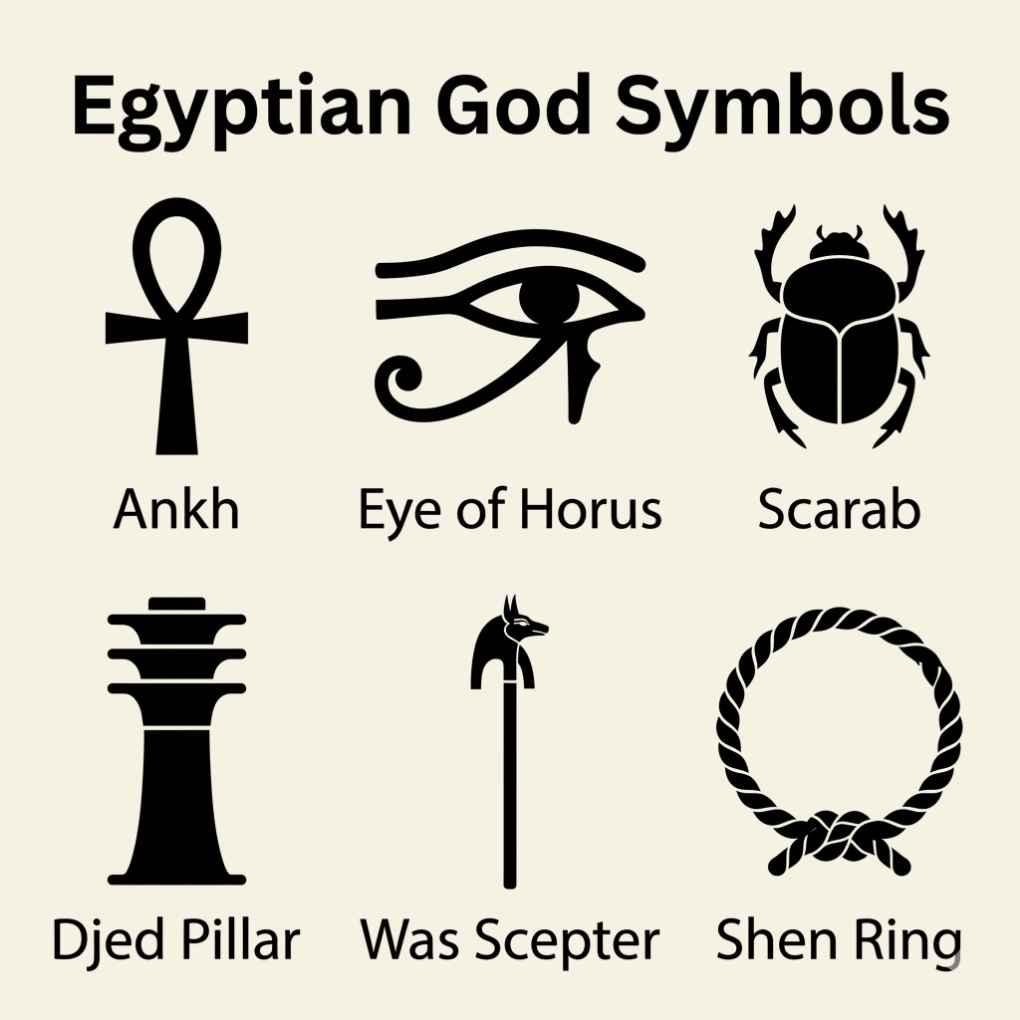
Egyptian sacred symbols were believed to carry literal divine power, not just represent it. The Ankh, shaped like a cross with a loop at the top, represented eternal life and was carried by gods as a key to divine wisdom. The Scarab Beetle symbolized rebirth and the rising sun. The Was Scepter represented divine authority held by pharaohs as earthly representatives of the gods.
Norse God Symbols
Norse god symbols carry raw elemental power. Thor’s Hammer (Mjolnir) was worn as a protective amulet by Viking warriors. Odin’s Ravens (Huginn and Muninn, meaning Thought and Memory) represented divine wisdom gathered from across the world. The Valknut, three interlocked triangles, is associated with Odin and the passage between life and death.
An important note: some Norse symbols have been misappropriated by white supremacist groups in the US. The genuine Norse spiritual community strongly rejects this misuse, and it’s worth researching symbols carefully before using them.
Hindu God Symbols
Hindu sacred symbols are among the richest and most layered in the world. Om is the most sacred, representing the primordial sound of creation itself. The Lotus represents spiritual purity rising above worldly attachment. The Trishul (Shiva’s trident) represents the three aspects of existence: creation, preservation, and destruction.
The Swastika deserves honest attention here. In Hindu tradition, it’s a 5,000-year-old symbol of prosperity, good fortune, and cosmic balance, used in temples and festivals across India and Southeast Asia. Its horrific misappropriation by Nazi Germany in the 20th century created a tragic cultural collision. Understanding both truths matters for anyone writing or learning about Hindu sacred symbols.
Aztec God Symbols
Aztec divine symbols connected gods to cosmic time cycles. The Sun Stone (often called the Aztec Calendar) encoded the entire Aztec cosmology into one circular design. Quetzalcoatl, the Feathered Serpent, represented the meeting point of earth and sky, knowledge and divinity. The Eagle symbolized the sun and warrior spirit.
Zeus God Symbols
Beyond the thunderbolt, Zeus was also represented by the Eagle (king of birds, mirroring Zeus as king of gods), the Oak Tree (considered the most powerful of trees), and the Bull. Each symbol reflects a different dimension of his divine personality: judgment, sovereignty, and raw natural power.
Hermes God Symbols
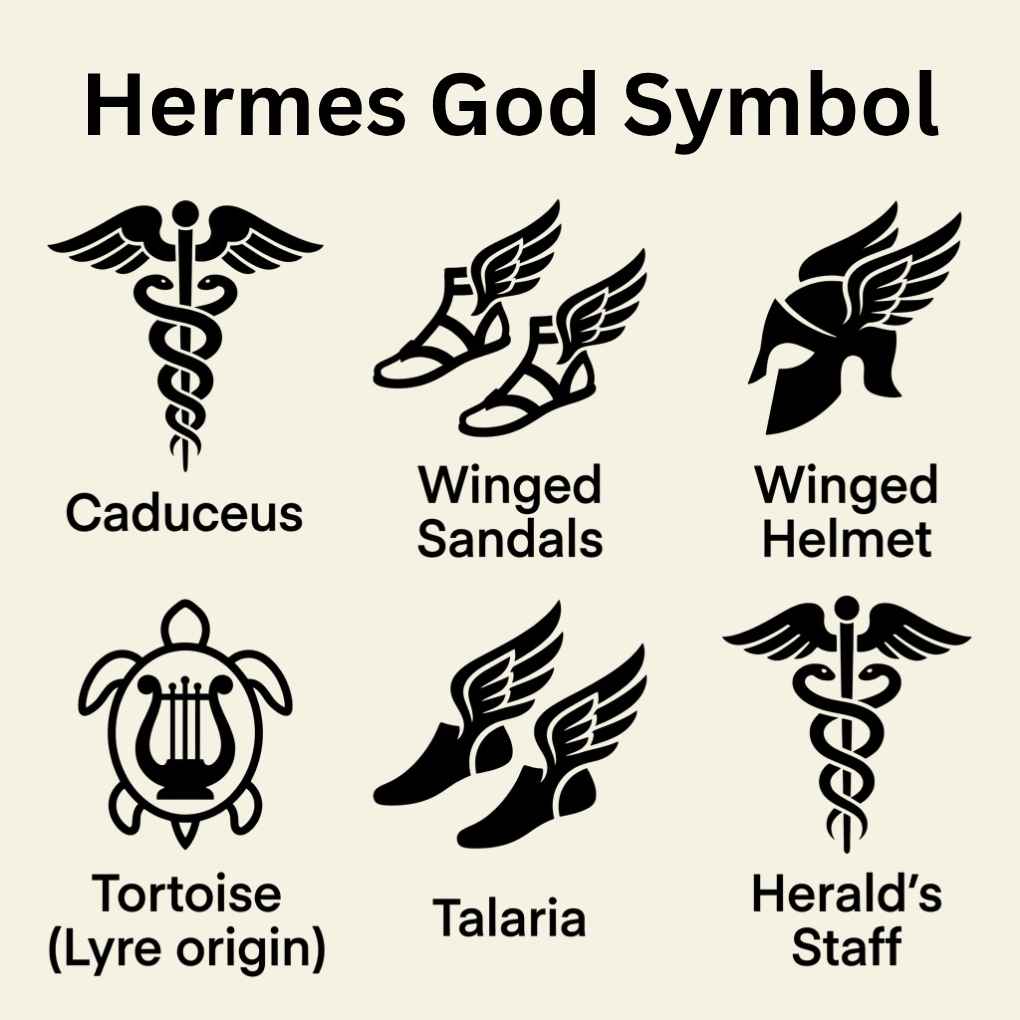
Hermes carried the Caduceus, a staff with two serpents coiled around it. Many Americans recognize this symbol because it’s frequently confused with the Rod of Asclepius, which features only one serpent and is the actual symbol of medicine. The Caduceus actually represents commerce and negotiation. It’s a widely repeated case of mythological symbols being misapplied in modern contexts.
Hades God Symbols
Hades is one of the most misunderstood figures in Greek mythology. He wasn’t evil. He was simply the ruler of the afterlife, a necessary cosmic role. His symbols, the Helm of Darkness (which granted invisibility), the three-headed dog Cerberus, and the bident, all reflect hidden power rather than malice. The popular video game Hades by Supergiant Games did an excellent job humanizing this god for modern audiences.
Pan God Symbols
Pan, the god of wilderness and nature, is represented by the Pan flute (syrinx), goat horns, and wild landscapes. His image, part man, part goat, is significant because early Christian artists borrowed it to shape visual depictions of the devil, a fascinating example of how one culture’s deity becomes another’s symbol of evil.
Jesus Symbols
Symbol For Jesus
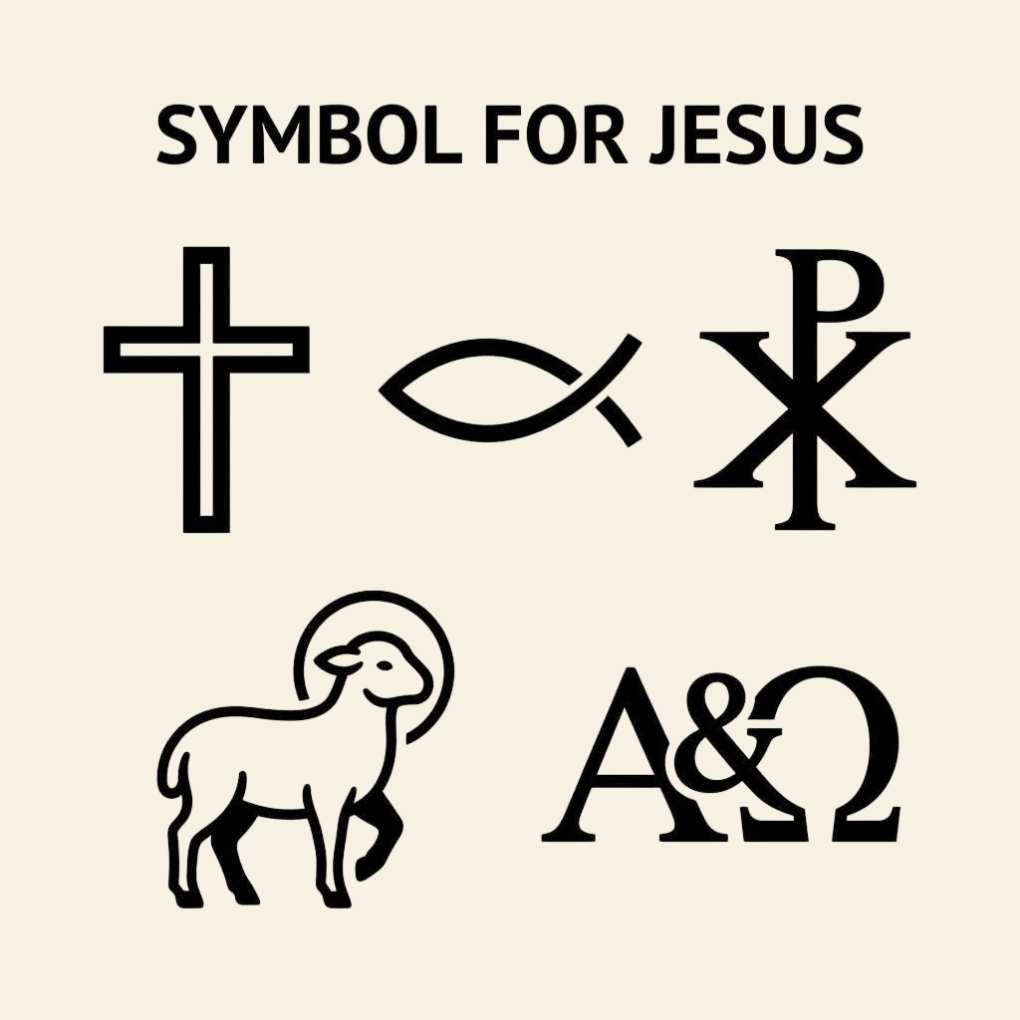
The cross is the most universally recognized symbol for Jesus Christ today, but early Christians actually avoided it. The fish symbol (Ichthys) was used first, functioning as a secret identifier among persecuted Christians in the Roman Empire. If you drew half the symbol in the dirt and a stranger completed it, you knew they were safe.
Jesus Symbol
Other important Jesus symbols include the Chi-Rho (the first two Greek letters of “Christ”), the Lamb of God (representing innocence and sacrifice), the Alpha and Omega (representing Jesus as the beginning and end of all things), and the Good Shepherd image, widely used in early Christian art.
Jesus Symbols And Symbols For Jesus
In American church culture, the cross dominates everything from jewelry to architecture to tattoos. But denominational differences are real. Eastern Orthodox churches emphasize the Chi-Rho and Byzantine iconography. Catholic tradition uses the crucifix (cross with Christ’s body). Protestant traditions often use the empty cross to emphasize resurrection over suffering. These subtle differences carry significant theological meaning.
Christian Symbols for God
God Symbols Christian
Christian symbols for God the Father differ from Jesus symbols. Light and fire appear throughout scripture as representations of God’s presence. The Dove represents the Holy Spirit. The All-Seeing Eye (found on the US dollar bill inside a triangle) has deep roots in Christian iconography, representing divine omniscience.
Symbol For God
Unlike many ancient religions, Christianity intentionally avoids a fixed visual image of God. This isn’t an accident. It reflects the theological belief that God transcends visual representation. Wind, fire, light, and water are used symbolically in scripture because they’re powerful without being containable.
Universal Symbol For God And Universal God Symbol
Across cultures that never interacted, the circle consistently appears as a universal symbol for the divine. A circle has no beginning and no end, making it a natural representation of eternal existence. The sun appears as a divine symbol in Egypt, the Americas, India, and Scandinavia independently. These cross-cultural parallels suggest that some symbols tap into something genuinely universal about human spiritual experience.
God Symbols and Tattoos
Symbols Of God
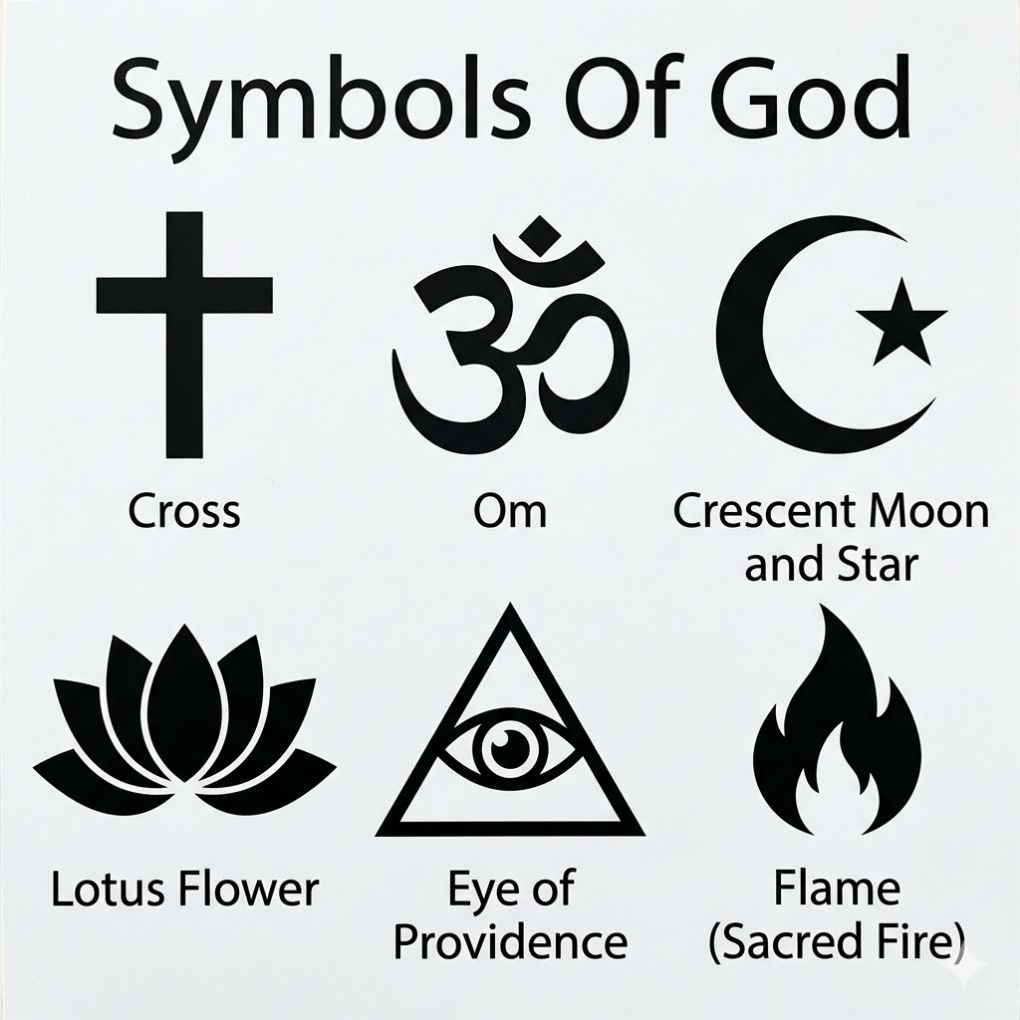
God symbol tattoos are deeply personal choices. Americans get these tattoos for reasons that range from faith declaration to grief processing to spiritual protection. The cross remains the most tattooed religious symbol in the United States by a significant margin.
God Symbolism
What makes a symbol powerful as a tattoo is the layering of personal meaning onto cultural history. When someone tattoos the Lotus on their arm after overcoming addiction, that ancient Hindu symbol of rising above murky water takes on entirely new personal dimensions without losing its original sacred meaning.
Divine Symbols
Some divine symbols are considered culturally sensitive to tattoo, particularly symbols sacred to living Indigenous, Hindu, or Buddhist communities. The general guidance from cultural sensitivity experts is straightforward: research the origin, understand the meaning, and approach sacred imagery with genuine respect rather than aesthetic convenience.
Deep Symbolic Meaning of God Symbols
On a Spiritual Level
In spiritual practice, god symbols function as anchors for focused attention. When a Buddhist meditates on a mandala or a Christian holds a cross during prayer, the symbol isn’t the object of worship. It’s a focal point that helps quiet the mental noise and deepen the sense of divine connection. Many practitioners describe this as the symbol serving as a doorway to higher consciousness.
On a Psychological Level
Carl Jung, one of the most influential psychologists of the 20th century, argued that certain symbols live in what he called the collective unconscious: a layer of the human mind shared across all people regardless of culture. He called these universal patterns archetypes.
God symbols, particularly circles, light imagery, and figures of authority, activate these archetypes and trigger feelings of awe, belonging, and reverence even in people who don’t consciously hold religious beliefs.
On a Cultural Level
God symbols are woven into American life in ways most people don’t notice. The Eye of Providence appears on the one-dollar bill. The phrase “In God We Trust” sits on every coin in circulation. State capitols and federal buildings feature religious architectural symbolism. These aren’t accidents. They reflect the deep cultural presence of sacred imagery in the foundations of American society.
Types and Variations of God Symbols
The seven most historically significant god symbols across world civilizations each carry a distinct story worth knowing.
| Symbol | Meaning | Common Use / Connection |
| Ankh | Life, rebirth, spiritual energy | Seen in ancient Egyptian art, temples, and charms |
| Eye of Horus | Protection, healing, inner strength | Found on jewelry, carvings, and protective objects |
| Om | Universal sound, spiritual balance | Used in Hindu meditation, scriptures, and temples |
| Cross | Faith, sacrifice, divine love | Common in Christianity, churches, and religious art |
| Star of David | Unity, divine connection, protection | Linked with Judaism and Jewish traditions |
| Crescent and Star | Guidance, hope, spiritual light | Appears in Islamic art, mosques, and flags |
| Thor’s Hammer | Strength, safety, blessing | Popular in Norse mythology and Viking culture |
God Symbols Across Cultures
Ancient Egyptians believed symbols held actual power, not just representational meaning. They placed Ankhs in tombs because they genuinely believed the symbol could help the soul survive death.
Ancient Greeks embedded their god symbols into civic life so thoroughly that even government buildings featured divine imagery as expressions of political legitimacy. In India, sacred symbols appear in temple architecture, body art, and daily ritual in ways that are completely inseparable from everyday life.
Across Abrahamic traditions, shared symbols of light, water, and fire point to surprising common ground between Judaism, Christianity, and Islam. Norse and Celtic knotwork designs encode the idea of eternal interconnection, that all living things are woven together in patterns that never truly end.
God Symbols in Art, Movies and Pop Culture
Renaissance painters like Michelangelo used halos, divine light rays, and sacred geometry to communicate holiness in ways that audiences immediately understood. In modern American film, religious symbolism drives major narratives constantly.
The cross in The Passion of the Christ, the divine light in Bruce Almighty, and the angelic imagery in countless superhero films all pull from the same ancient visual vocabulary.
Tolkien built the entire spiritual framework of Middle-earth on mythological divine symbols. Video games like Hades, Assassin’s Creed, and God of War have introduced millions of young Americans to these symbols through immersive storytelling, creating a new generation of mythology enthusiasts.
Spiritual and Dream Meaning of God Symbols
Dreaming of a cross is widely interpreted as a signal of spiritual awakening, a call toward deeper faith, or a need for guidance during a difficult period. Dreaming of divine light, particularly in traditions influenced by Jungian psychology, often represents emerging clarity and inner transformation.
In Buddhist dream interpretation, seeing sacred symbols during sleep is considered a positive sign of spiritual progress. Many meditation practitioners deliberately visualize god symbols like the mandala or Om during practice, using them as anchors to reach deeper states of focused awareness.
Positive vs Negative Meaning
The same symbol can represent liberation for one person and oppression for another. The cross symbolizes salvation and love for billions of Christians but carries associations with forced conversion for many Indigenous communities worldwide.
The Swastika is sacred in Hindu households and deeply traumatic for Holocaust survivors and their descendants. These dual realities don’t cancel each other out. They exist simultaneously, which is why context, intention, and historical awareness matter so much when engaging with divine symbols.
Why Humans Are Attracted to God Symbols
Humans are pattern-recognition creatures by nature. Our brains are wired to find meaning in shapes, repetition, and visual order. Sacred symbols activate that wiring at a deep level. Psychologists suggest that symbols reduce existential anxiety by giving visible form to invisible forces, whether that’s God, the universe, or the mystery of death. On a social level, shared sacred symbols create powerful bonds of community and identity. They answer the deepest questions we carry: Am I protected? Do I matter? Is there something beyond this life?
That’s why god symbols have survived every empire, every revolution, and every technological transformation in human history. They endure because the questions they answer never go away.
FAQs
What is the most universally recognized god symbol across all cultures?
The cross, Om, and circle appear most consistently across cultures worldwide as divine symbols.
What do Greek god symbols represent in modern tattoo culture?
Greek god tattoos represent personal strength, wisdom, protection, and deep admiration for ancient mythology.
Why do similar god symbols appear in cultures that never met each other?
Shared human experiences like sun, death, and creation naturally produced similar sacred symbols everywhere.
What is the difference between a religious symbol and a deity symbol?
Deity symbols represent specific gods while religious symbols represent broader faith, belief, and spiritual tradition.
Are god symbols still spiritually relevant and meaningful for people today?
Yes, millions use god symbols daily for meditation, prayer, tattoos, and expressing personal spiritual identity.
Conclusion
God symbols are more than ancient art or religious decoration. They’re humanity’s oldest attempt to bridge the gap between what we can see and what we can only feel. Whether it’s the Ankh carved in an Egyptian tomb, the Om chanted in a morning yoga class in California, or a cross worn as a necklace by someone grieving a loss, these sacred symbols carry thousands of years of human longing, faith, and hope compressed into a single image.
Understanding them doesn’t require religious belief. It only requires curiosity and respect. When you look at a god symbol, you’re seeing the distilled spiritual wisdom of entire civilizations reaching across time to remind you that you’re part of something much larger than yourself.

Mubeen is a passionate writer at Auramegazine who explores symbolism, hidden meanings, and powerful signs behind everyday symbols. He enjoys creating simple, engaging content that helps readers understand deeper meanings and cultural connections.