45+ Puerto Rican Symbols That Reveal the Island’s True Soul
Puerto Rican symbols are visual, spiritual, and cultural expressions that carry centuries of identity, resistance, and pride within every image, carving, and color. Whether you’re Puerto Rican by birth, by ancestry, or simply someone who loves the culture, understanding these symbols opens a window into one of the most layered and beautiful heritages in the world.
Puerto Rico’s symbolic identity draws from three powerful roots: the Taíno indigenous civilization, Spanish colonial history, and African heritage. Each layer added new meaning, and together they created a symbolic language unlike anything else in the Caribbean. Today, with nearly 6 million Puerto Ricans living in the continental United States, these symbols travel far beyond the island. They’re tattooed on skin, painted on walls, worn as jewelry, and carried in hearts across the country.
This guide covers 45+ Puerto Rican symbols, their cultural meanings, spiritual significance, and why they still matter deeply to people today.
What Are Puerto Rican Symbols?
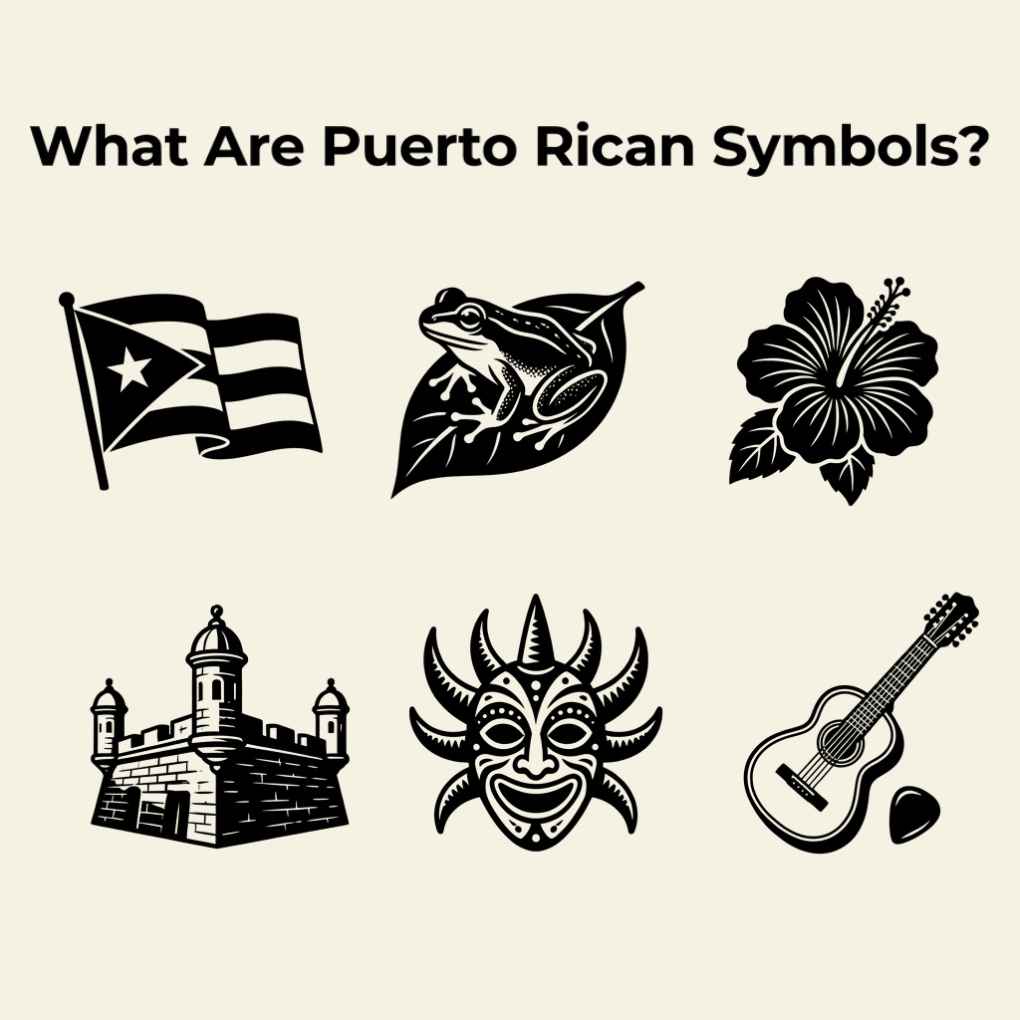
Puerto Rican symbols are representations of the island’s identity, beliefs, and history. They show up in tattoos, murals, jewelry, architecture, and everyday life. But they’re far more than decoration. Each symbol tells a story about survival, belonging, and what it means to be Boricua.
The history of these symbols stretches back more than a thousand years. Before Spanish ships arrived in 1493, the Taíno people carved their beliefs into stone at sacred sites like Caguana Indigenous Ceremonial Park in Utuado. These petroglyphs depicted gods, animals, and spiritual forces in geometric patterns that still inspire artists today.
When colonization began, Spanish religious imagery merged with Taíno traditions. Crosses, saints, and royal emblems layered on top of indigenous symbols without erasing them completely. Then, through the transatlantic slave trade, West African spiritual traditions arrived and added another dimension, bringing new symbols, rhythms, and resilience into Puerto Rican culture. The result is a rich symbolic ecosystem where ancient and modern coexist.
Puerto Rican Symbols And Their Cultural Meanings
Every Puerto Rican cultural symbol operates on multiple levels at once. On the surface, you see an image. Underneath that image sits an emotion, a history, and sometimes a political statement.
Puerto Rican symbols generally fall into three emotional categories. Pride symbols like the flag and the coqui frog celebrate identity and belonging. Protection symbols rooted in Taíno and African spiritual traditions guard families and communities from harm. Spiritual symbols connect the living to ancestors and divine forces. Understanding which category a symbol belongs to helps you grasp why it matters so deeply to the people who use it.
Puerto Rican Symbols And Meanings
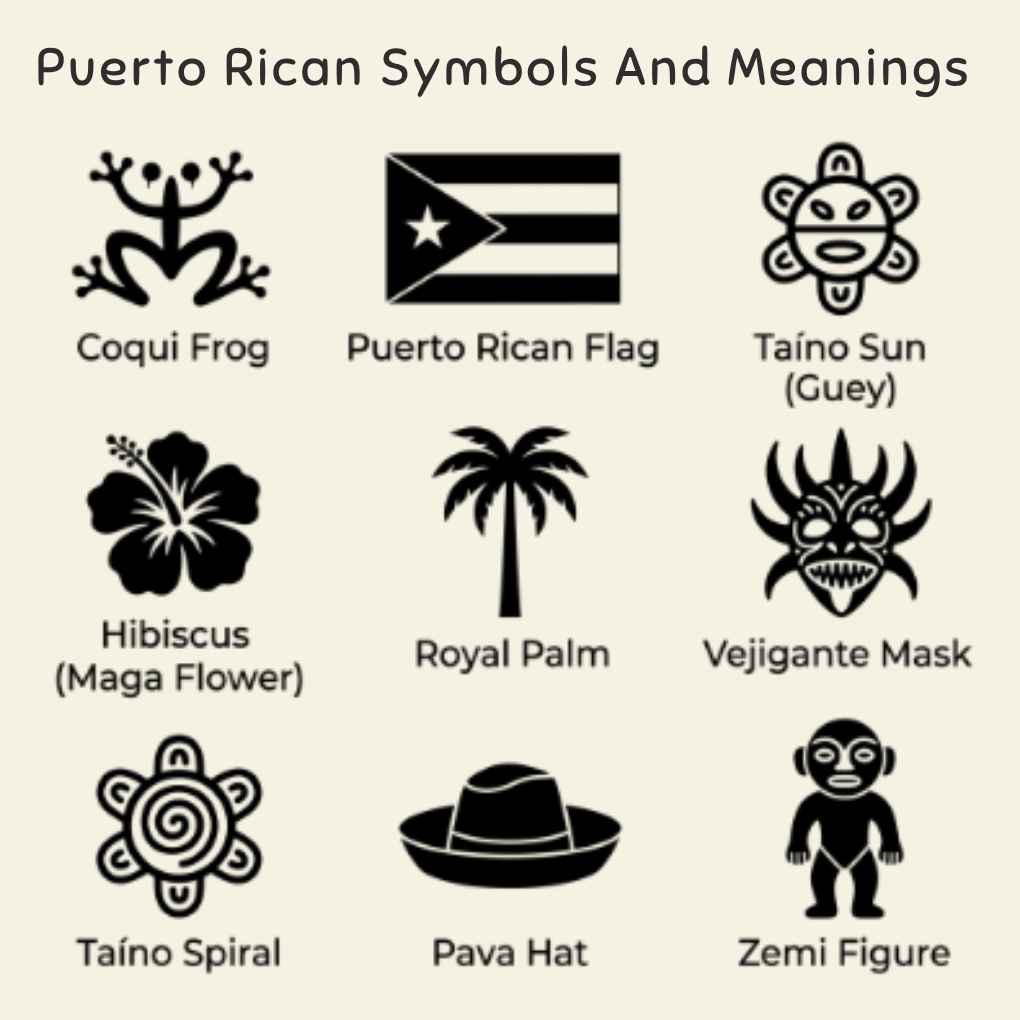
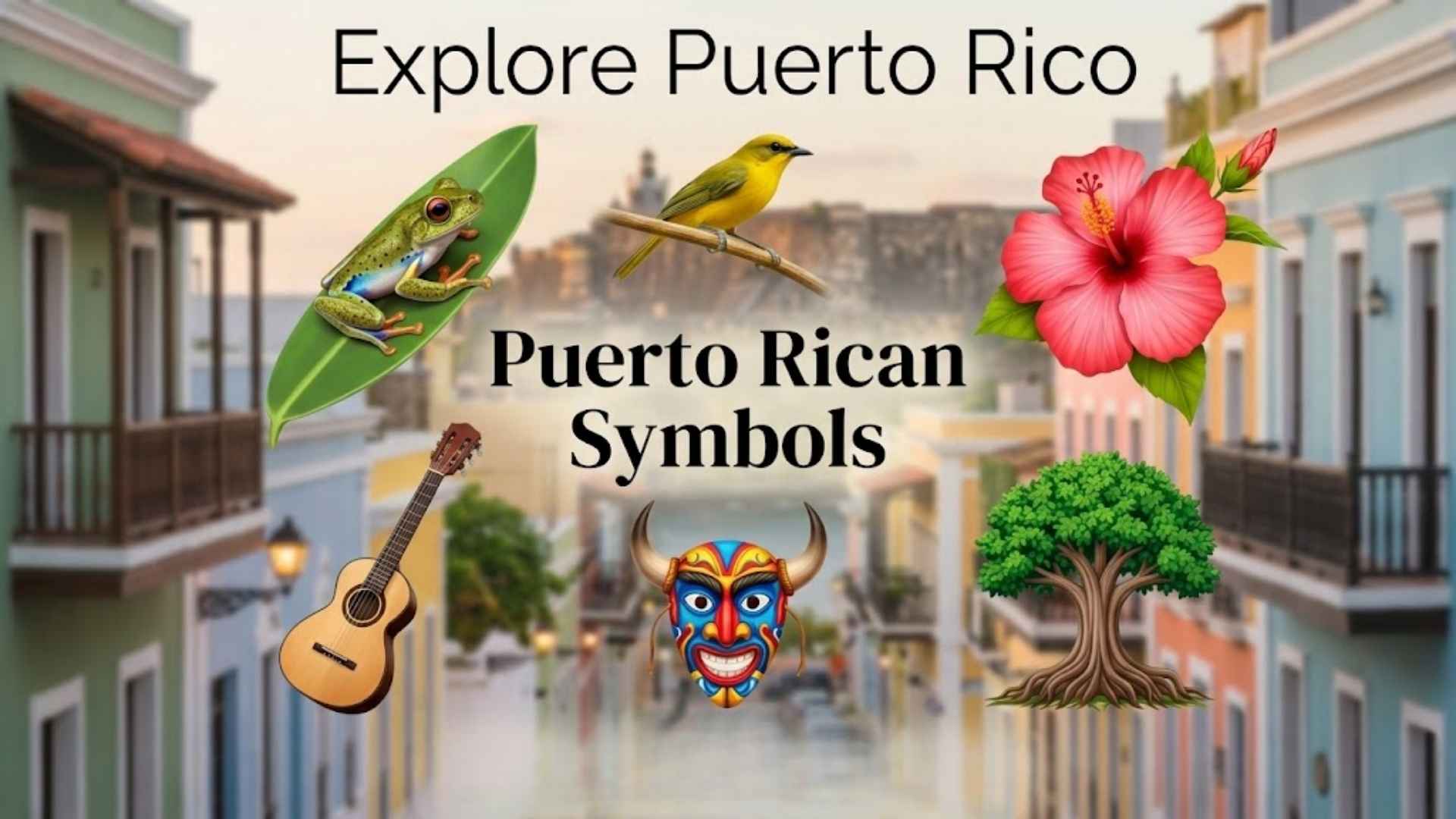
Here’s a quick reference guide to the most significant Puerto Rican symbols and their meanings:
| Symbol | Meaning |
| Coqui Frog | Home, pride, natural belonging |
| Puerto Rican Flag | Freedom, sacrifice, unity |
| Taíno Sun (Guey) | Life force, divine energy, spiritual power |
| Hibiscus (Maga Flower) | Natural beauty, island uniqueness |
| Royal Palm | Strength, dignity, resilience |
| Vejigante Mask | African heritage, carnival tradition, spiritual protection |
| Taíno Spiral | Life cycles, transformation, ancestral connection |
| Pava Hat | Rural Jibaro identity, working-class pride |
| Zemi Figure | Ancestral spirit, protection, Taíno sacred energy |
These symbols aren’t static. They evolve with each generation of Puerto Ricans who carry them into new cities, new conversations, and new art forms.
Puerto Rican Symbols Tattoos
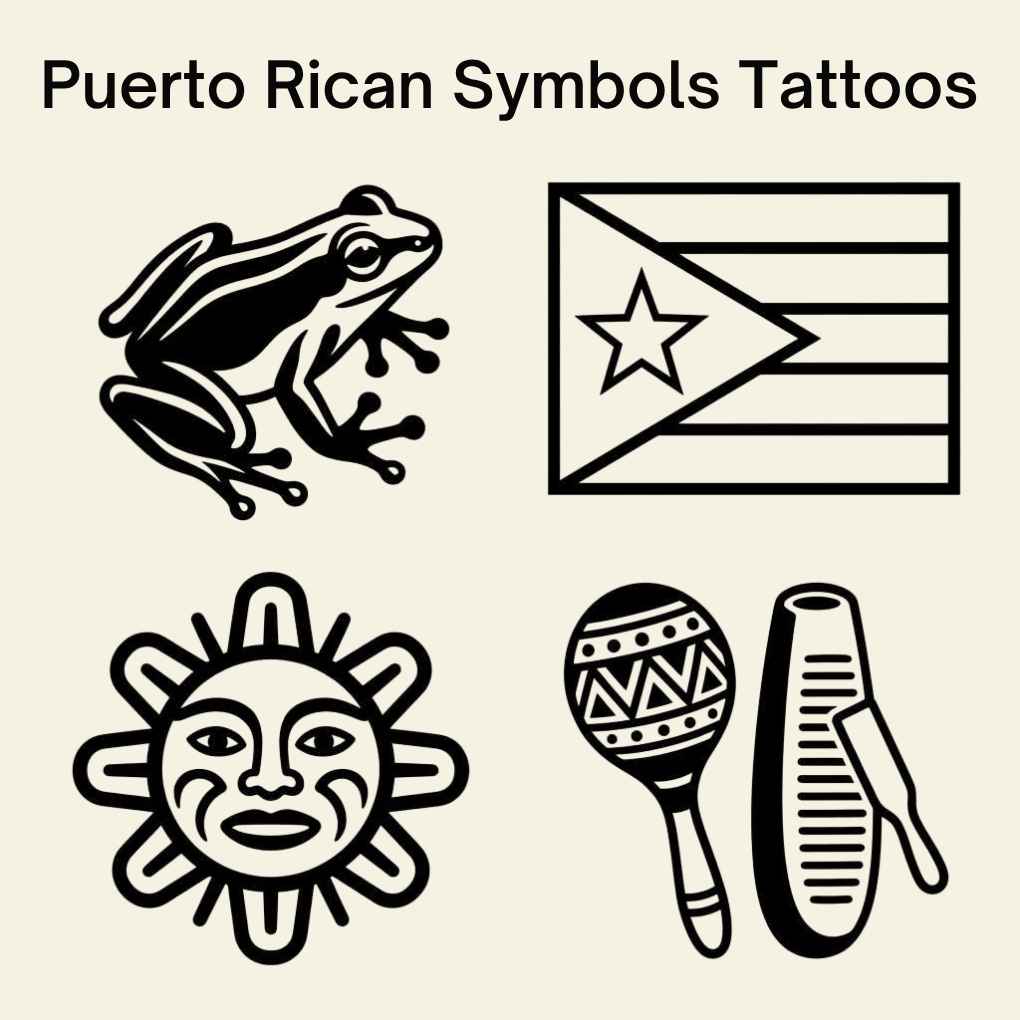
Puerto Rican tattoos have become one of the most popular ways to express cultural pride, especially in US cities like New York, Chicago, and Orlando. The coqui frog, the Taíno sun, and the Puerto Rican flag are among the most requested designs.
What makes these tattoos powerful is the personal story behind them. A Puerto Rican raised in the Bronx might get a coqui tattoo as a way of saying, “No matter how far I go, I carry home with me.” A young woman might choose the Maga hibiscus to honor her grandmother’s garden back on the island.
If you’re considering a Puerto Rican symbol tattoo, take time to understand what you’re choosing. These symbols carry real cultural weight, and approaching them with knowledge and respect makes the art more meaningful for everyone.
Taino Symbols And Meanings
The Taíno people were the indigenous inhabitants of Puerto Rico and the Caribbean, and their symbolic language was rich and spiritually layered. Central to Taíno belief was the concept of zemis, sacred figures representing gods, ancestral spirits, and natural forces.
Key Taíno symbols include:
- Atabey: The mother goddess of water and fertility, often depicted as a frog-like figure. She was invoked during childbirth and river crossings.
- Guey (Taíno Sun): A circular face with radiating geometric rays, representing life, divine authority, and guidance.
- The Cobo (Conch Shell): Used in ceremonies and communication, it symbolized spiritual calling.
- The Turtle: Representing longevity, wisdom, and the earth as a living being.
- The Bat: Connected to nighttime spiritual travel and the underworld in Taíno mythology.
These ancient Puerto Rican symbols are carved into stone at sites like Cueva del Indio in Arecibo and Caguana Ceremonial Park. They’re not museum pieces. They’re actively used by Puerto Ricans today in tattoos, jewelry, and spiritual practice.
Taino Puerto Rican Symbols Tattoos
Taíno-inspired tattoo art has its own distinct visual style. Unlike realistic illustrations, Taíno tattoos use geometric, symmetrical lines similar to the original petroglyphs. Popular designs include the Atabey figure, the Guey sun circle, cemi face carvings, and turtle patterns with geometric shells.
A Taíno tattoo revival movement is growing, led by artists in San Juan’s Santurce neighborhood and in New York City. Many Taíno-descended Puerto Ricans see getting these tattoos as an act of ancestral reconnection, particularly as DNA research has confirmed Taíno genetic markers in a significant portion of modern Puerto Ricans.
You May Also Like: Winter Symbols Explained | The Spiritual Messages of Snow, Fire and Silence for 2026
Famous Symbols That Represent Puerto Rico
Taino Sun Symbol Meaning
The Taíno sun symbol, called Guey, is one of the oldest and most recognized images in Puerto Rican culture. Visually, it’s a circular face with geometric rays extending outward, often with human features at the center. The Taíno believed the sun was a conscious being, not just a celestial object, which is why the face is central to the design.
Its meaning covers life force, divine power, and directional guidance. The sun sustains all living things, tells you where you are, and governs the rhythm of each day. In Taíno spiritual symbolism, the sun was closely connected to agricultural cycles and community gathering. Archaeologists have dated some Guey carvings to over 1,000 years before Spanish colonization.
Today, the Taíno sun symbol appears in tattoos, jewelry, murals, and Puerto Rican cultural art across the island and the US diaspora. It’s arguably the most tattooed Puerto Rican symbol among people reconnecting with their indigenous Caribbean heritage.
Puerto Rico Symbol Frog (The Coqui)
The coqui frog is Puerto Rico’s most emotionally powerful symbol. Its scientific name is Eleutherodactylus coqui, and there are 17 species native to the island. It’s named for its two-syllable nighttime call: “ko-KEE.” Only the male sings, using the “ko” sound to warn rival males and the “KEE” sound to attract females.
What makes the coqui extraordinary as a cultural identity symbol is its biology. It cannot survive outside Puerto Rico’s native climate. When attempts were made to introduce it to Hawaii, it became invasive and failed to thrive the way it does in Puerto Rico. This fact became a metaphor that Puerto Ricans embraced: “Soy de aquí como el coquí” (I’m from here like the coqui).
For Puerto Ricans in the continental US, the coqui carries deep emotional weight. Many play recordings of its call as a form of comfort and connection. The Puerto Rican government officially recognized it as a national cultural symbol, and it appears on official seals, tourism branding, and children’s books.
Puerto Rican Protection Symbols
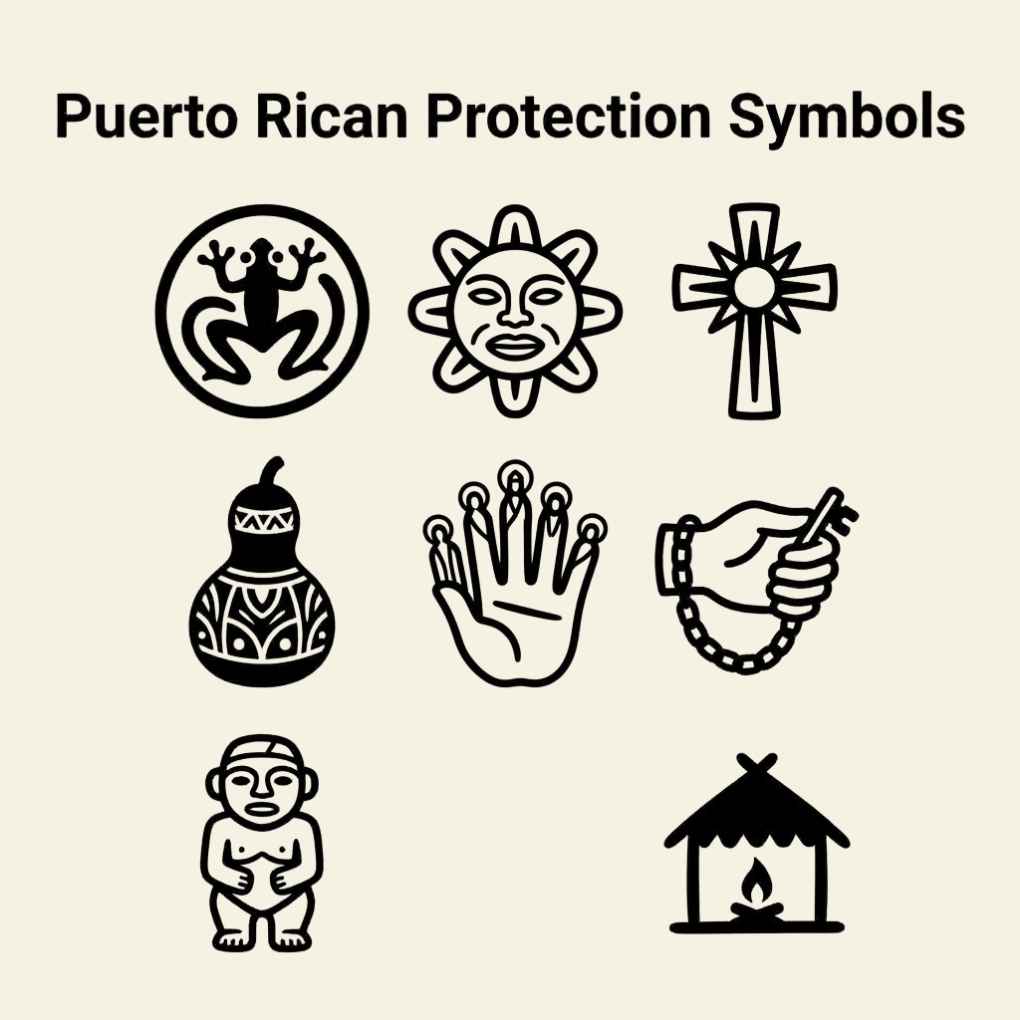
Puerto Rican protection symbols draw from all three cultural roots. In Taíno tradition, Atabey was invoked to protect during childbirth and water crossings. Cemi figures were kept in homes to guard families from negative spiritual energy. The bat symbol was used in rituals for nighttime protection.
From Spanish colonial influence, San Juan Bautista (Saint John the Baptist), the patron saint of Puerto Rico, became a protective figure. His image appears in churches, home altars, and personal jewelry across the island.
African-derived traditions added elekes, beaded necklaces in specific colors representing orishas (divine beings) in Santeria and Lucumí practice. Many Puerto Ricans combine these traditions, wearing a cemi pendant alongside a Catholic saint medal, blending layers of spiritual protection into a single piece of jewelry.
Traditional Puerto Rico Symbols And National Identity
Puerto Rico National Symbols
Puerto Rico’s officially recognized national symbols were designated by the government over different decades and reflect the island’s natural environment and cultural pride:
- National Bird: The Puerto Rican Spindalis (Reina Mora), a brilliantly colored bird found only on the island
- National Flower: The Maga (Thespesia grandiflora), a deep red hibiscus relative endemic to Puerto Rico
- National Tree: The Royal Palm (Palma Real), representing dignity and resilience
- National Anthem: La Borinqueña, which uses the Taíno name for the island (Borinquen)
- Coat of Arms: Granted by Spain in 1511, one of the oldest in the Western Hemisphere
These Puerto Rico national symbols aren’t just official designations. They’re woven into daily life, celebrations, and the emotional vocabulary of Puerto Rican identity.
Puerto Rican Flag Meaning
The Puerto Rican flag was designed by Puerto Rican exiles in New York City in 1895 during the independence movement, directly inspired by the Cuban flag. Its design carries real historical weight:
- Red stripes: The blood of patriots who fought for freedom
- White stripes: Peace, victory, and the purity of ideals
- Blue triangle: The surrounding sea and sky
- White star: The island of Puerto Rico itself
What many people don’t know is that under Law 53 of 1948, also called the “Gag Law,” displaying the Puerto Rican flag was illegal and could result in imprisonment. This history transforms the flag from a simple national emblem into a symbol of cultural resistance. Today, it flies proudly at the world’s largest Puerto Rican Day Parade in New York City, carried by millions as an act of joyful defiance.
Deep Symbolic Meaning
Puerto Rican symbols work on three levels simultaneously. Spiritually, they connect to Taíno gods, Catholic saints, and African orishas. Psychologically, they anchor identity and create belonging across geographic distance. Politically, they represent resistance and self-determination for a people navigating a complex colonial reality.
For the nearly 6 million Puerto Ricans living in the continental US (more than live on the island itself), these symbols serve as portable pieces of home. Research in cultural psychology shows that diaspora communities who maintain strong connections to their cultural symbols report higher levels of identity security and resilience. A coqui tattoo isn’t just ink. It’s an emotional anchor in unfamiliar territory.
The political dimension is especially important. Puerto Rico’s ambiguous status as a US territory, neither a state nor an independent nation, makes Puerto Rican cultural identity something that must be actively maintained. Symbols become the language of that maintenance.
Types and Variations of Puerto Rican Symbols
The Coquí Frog
Small, brown or green, with round eyes and tiny gripping fingers, the coqui punches far above its weight as a cultural icon. It appears in children’s books, fine art, restaurant names, tourism logos, and baby shower decorations. Its simple, recognizable shape makes it one of the most versatile symbols in Puerto Rican iconography.
The Sun Symbol (Taíno Sun)
The Guey sun circle with its geometric face and radiating rays is the most tattooed Puerto Rican symbol in the US diaspora community. Its ancient origin (over 1,000 years before Spanish arrival) gives it deep ancestral wisdom and authority as a symbol of indigenous pride.
The Puerto Rican Flag
Beyond its design, the flag’s emotional power comes from its history of being banned, reclaimed, and celebrated. It’s a living symbol that grows more meaningful with each generation that carries it.
The Hibiscus Flower
The Maga hibiscus, Puerto Rico’s national flower, is endemic to the island. Puerto Rican families across the US often grow hibiscus plants in their homes as living connections to the island’s natural beauty and Caribbean heritage.
The Taíno Spiral
Found carved in rocks across Puerto Rico, the Taíno spiral represents life cycles, water movement, and the path between the physical and spirit worlds. It mirrors patterns found in conch shells, ocean waves, and plant growth, all sacred in Taíno cosmology.
Puerto Rican Symbols Across Cultures
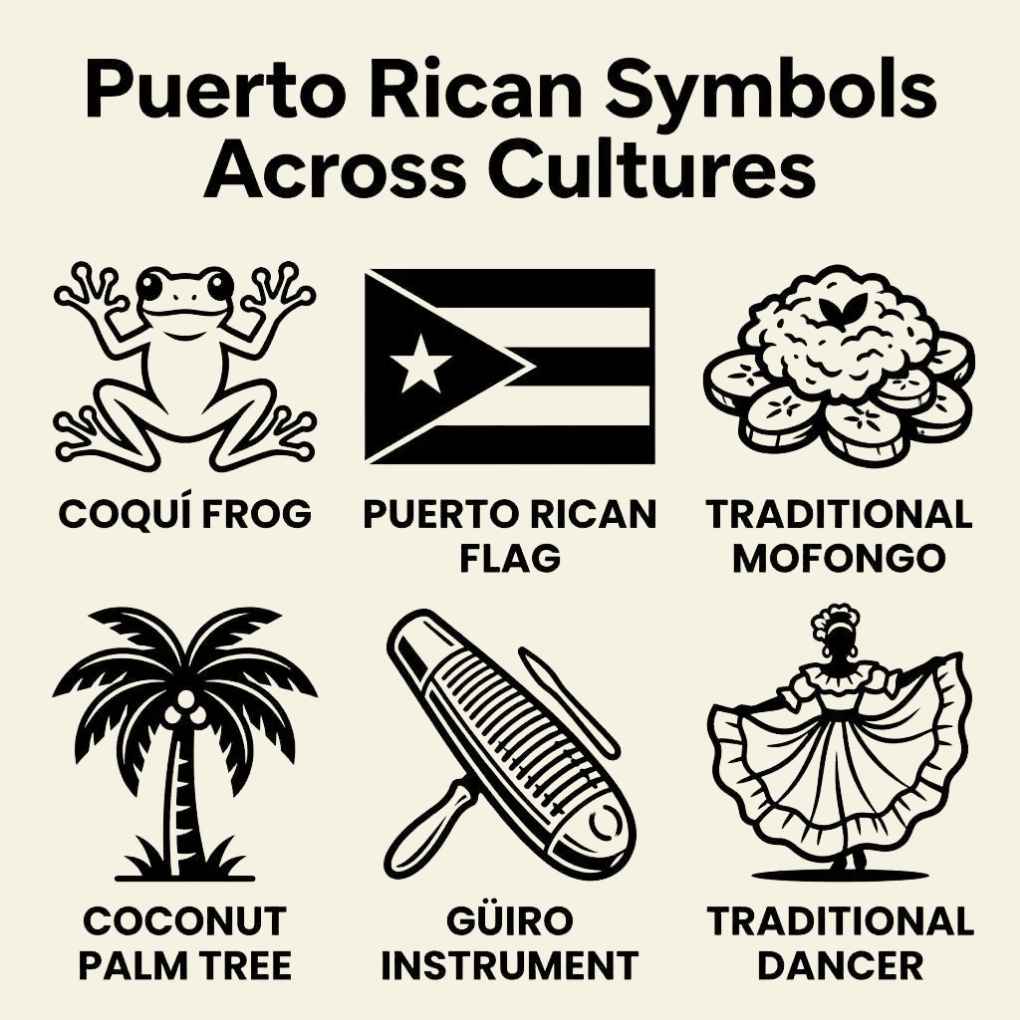
Puerto Rican symbols have never existed in isolation. They traveled, merged, and evolved across centuries. In the Taíno era, every carving served a sacred purpose. Under Spanish colonization, indigenous symbols survived by blending with Catholic imagery. African traditions arriving through the slave trade added new spiritual dimensions, giving birth to practices like Espiritismo and Santeria that carry their own rich symbolic language.
In the US diaspora, these symbols became markers of cultural resilience against assimilation pressure. The vejigante mask, originating in the Carnivals of Ponce and Loíza, has influenced carnival traditions across the Caribbean and Latin America.
Puerto Rican Symbols in Art, Movies and Pop Culture
Puerto Rican cultural symbols have entered mainstream American pop culture in powerful ways. Bad Bunny, one of the world’s most-streamed artists, incorporates Puerto Rican flag imagery and coqui references into his visual brand consistently. The 2021 film In the Heights wove Puerto Rican and Dominican symbols throughout its visual storytelling of New York’s Washington Heights community.
Post-Hurricane Maria in 2017, Puerto Rican symbolic art exploded across San Juan’s Santurce neighborhood. Artists painted enormous murals featuring Taíno symbols, coqui frogs, and Afro-Puerto Rican imagery as acts of collective healing. These murals transformed Puerto Rican symbolic traditions into public declarations of survival and resilience.
Spiritual and Dream Meaning of Puerto Rican Symbols
In dreams, Puerto Rican spiritual symbols carry personal messages. Hearing the coqui in a dream often signals longing for home or a need to reconnect with roots. Seeing the Taíno sun suggests awakening and clarity. A spiral symbol in a dream typically points to personal growth and transformation in progress.
In Espiritismo, Puerto Rico’s indigenous folk spiritualism, symbols are used in altar arrangements, cleansing ceremonies (limpiezas), and healing rituals that blend Taíno, African, and Catholic traditions. Many Puerto Rican families maintain home altars where sacred symbols from multiple traditions coexist peacefully.
Positive vs Negative Meaning
Every powerful symbol carries complexity, and Puerto Rican symbols are no exception. Positively, they represent pride, belonging, resilience, and beauty. They help Puerto Ricans feel seen and connected across distance.
The contested meanings are equally real. The Puerto Rican flag means different things to independence advocates, statehood supporters, and commonwealth defenders. Spanish colonial symbols carry historical trauma for some and genuine spiritual heritage for others. Taíno symbols used without understanding can feel disrespectful to indigenous-identified Puerto Ricans.
This complexity doesn’t weaken these symbols. It deepens them. They hold real human history, and real history is never simple.
Why Humans Are Attracted to Puerto Rican Symbols
Humans are symbol-making creatures. We’ve been carving meaning into stone for over 40,000 years. Puerto Rican symbols attract people because they compress generations of real experience, love, loss, resistance, and celebration into a single image.
For Puerto Ricans, these symbols create instant community. Two strangers with coqui tattoos feel a connection before they’ve said a word. For non-Puerto Ricans, the beauty, depth, and emotional weight of these symbols represent something universal: the human need to belong, remember, and celebrate where you come from.
You don’t have to be Puerto Rican to feel moved by these symbols. But understanding them will always deepen your appreciation of a culture that has given the world extraordinary music, art, resilience, and soul.
Conclusion
Puerto Rican symbols are declarations. Each one carries the heartbeat of a people shaped by Taíno wisdom, Spanish history, African strength, and an unbreakable will to remain themselves through every storm, literal and political.
For millions of Puerto Ricans across the US, these symbols are daily acts of cultural preservation. They’re on refrigerator magnets in Chicago apartments, tattooed on arms in New York, planted as hibiscus in California gardens, and playing as coqui sounds on phones in Florida. They travel because the people who carry them travel, and they survive because Puerto Rican identity is simply too vibrant to disappear.
Whatever symbol speaks to you, know that behind it sits an entire world of meaning waiting to be explored.

Mubeen is a passionate writer at Auramegazine who explores symbolism, hidden meanings, and powerful signs behind everyday symbols. He enjoys creating simple, engaging content that helps readers understand deeper meanings and cultural connections.